Skip to content
Search authority builds

Your buyers stopped clicking. They still ask.

Answer engines now sit between your firm and the people looking for it. The pages that used to earn a click get read, summarised and cited — or skipped. I rebuild the layer underneath: a search foundation that machines can quote correctly, a marketing operation that keeps it current, and the website both run on. I do the work myself and hand over the manual.

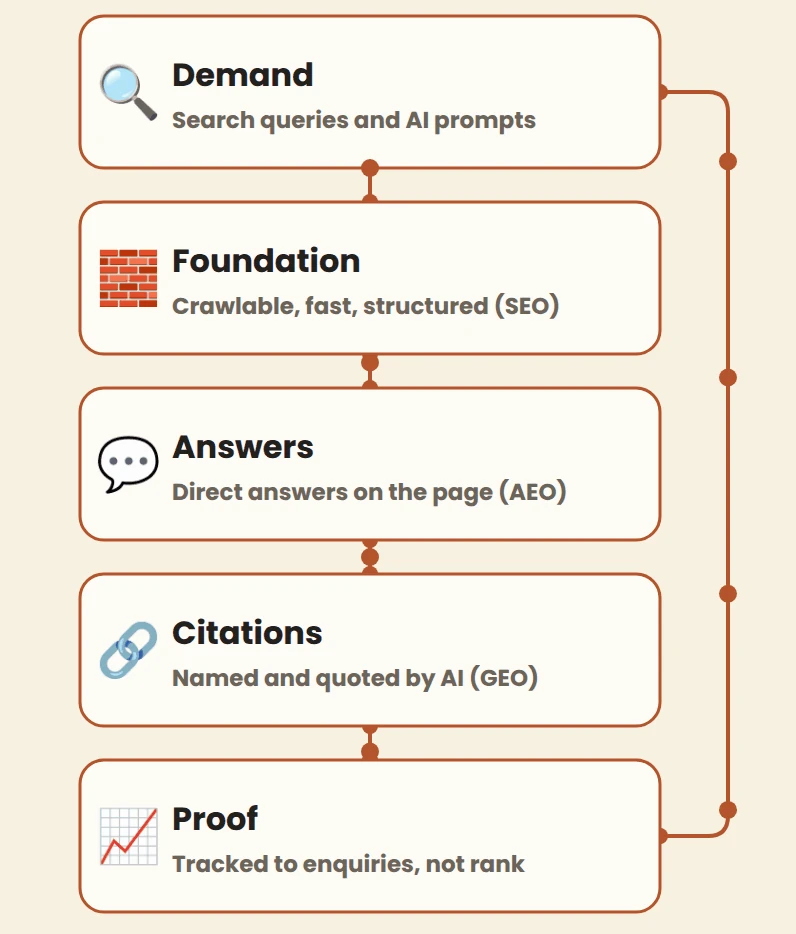
Flow diagram: demand feeds a crawlable foundation, which produces on-page answers, which earn AI citations, which are tracked as proof, looping back to demand
Fig. 01 — The search visibility loop: demand, foundation, answers, citations, proof
On the record
Founder, Maple Commerce
Marketing strategy practice
Founder, BestCourses.sg
Course discovery for Singapore learners
Adjunct trainer
AI and digital marketing programmes
Sixteen years in-house and agency-side
B2B and professional services, SEA
Sixteen years of work, most of it inside other people's marketing departments.
Brands worked on

Across agency and in-house roles, on campaigns, search programmes and marketing systems.

Michelin
Decathlon
Singtel
SingHealth
Google
American Express
Hotels.com
Hyatt
Canon
Nikon
General Electric
Pizza Hut
Rise by BCG
Singapore Tourism Board
World Vision
The situation

You have the plan. What is missing is the thing that runs.

Most firms I meet have been advised well. There is a positioning document, a content calendar, a keyword list and a quote for a website. None of it is wired together, nobody owns the build, and the plan has been sitting for eight months.

Meanwhile the ground moved. Buyers ask an assistant before they open a browser tab, and the assistant answers from whatever it can parse — your competitor's structured pages, a directory listing, a five-year-old article. Being findable is now a build problem, not a content problem.

Implementation is a different job from advice. It means sitting inside your systems, making the unglamorous decisions about schema and redirects and review steps, and staying until it works. That is the only job I take.

What I build

One lead build, two attachments.

Specifications, not brochures. Each one states its inputs, its deliverables, and what still runs after I leave.

Lead build Ref. SAB — 6 to 8 weeks

Search Authority Build

The foundation that decides whether your firm gets cited or paraphrased away. Technical corrections first, then entity and schema work so machines know what you are and what you do, then a page structure organised around the questions buyers actually ask — including the ones they now put to an assistant instead of a search box.

Inputs I need
Search Console, analytics, CMS access, and ninety minutes each with two people who talk to buyers.
Deliverables
Technical fix log, entity and schema layer, information architecture, twelve to eighteen briefed pages.
Measured by
Non-branded organic sessions, assistant citation checks on a fixed query set, enquiries attributed to organic.
Runs without me
Schema templates in your CMS, a monthly check script, and the brief format your writers reuse.
Discuss a search authority build →
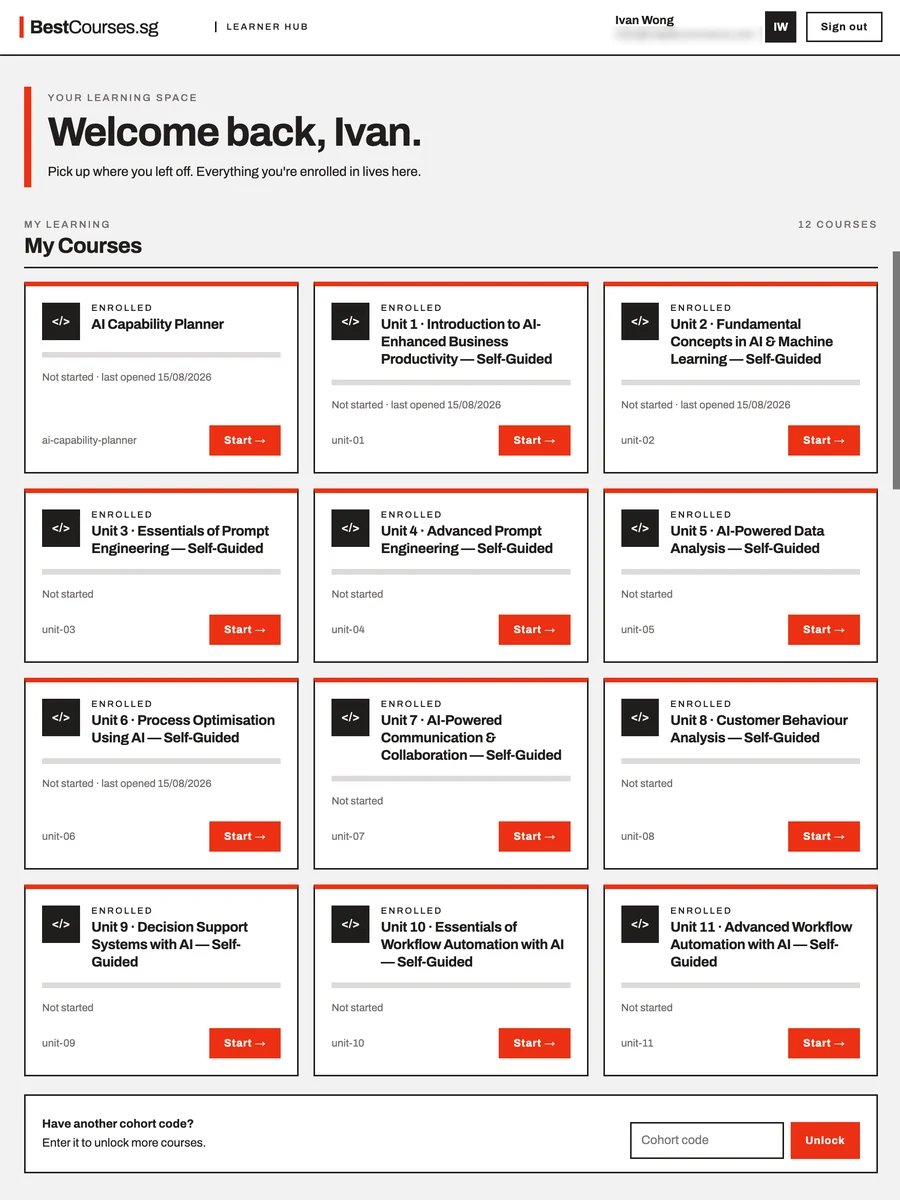
BestCourses.sg learner hub dashboard listing enrolled AI courses
Artefact — BestCourses.sg learner hub, built and run in-house
Attach — Ref. AMO, 8 to 12 weeks

AI Marketing Operations Build

The system that keeps the search foundation fed. Workflows rebuilt around a small set of AI-assisted steps with a human check at every decision, wired to your CRM, with the prompt library versioned and the review trail auditable.

Attach — Ref. CWB, 4 to 6 weeks

Conversion Website Build

A site built to be measured, not admired. Message architecture, page structure that carries the schema layer, tracking that matches your CRM fields, and a build your team can edit without calling anyone.

Build log

What I built, when, and what changed after.

Every entry names the system touched and my exact role. Client names are attached where I have permission to use them.

2025.03 — 2025.10
B2B industrial supplier
Client name — pending approval
Problem

A 400-page catalogue ranked for product codes and nothing else. Buyers searching by application never arrived.

Intervention

Rebuilt the architecture around applications, consolidated 90 thin pages into 14, added product and FAQ schema, cleared a redirect chain eating crawl budget.

Outcome

Non-branded organic sessions up 2.4× in seven months. Quote requests from organic from 6 to 21 a month.

My role — sole builder: architecture, briefs, schema, technical fixes
2025.06 — 2025.11
Corporate training provider
Client name — pending approval
Problem

Enquiries arrived across three inboxes and a WhatsApp number. Nobody could say which course pages produced them.

Intervention

One intake form and CRM pipeline, source captured at submission, AI-assisted first-response drafts reviewed by the coordinator before sending.

Outcome

First response fell from 31 hours to under 3. Enquiry-to-booked-call moved from 18% to 29% over two quarters.

My role — sole builder: CRM configuration, forms, prompt library, training
2025.09 — 2026.07
Professional services firm
Client name — pending approval
Problem

Two partners wrote all the content between client work. Publishing stopped whenever the firm got busy, which was always.

Intervention

A drafting workflow built on the partners' own transcripts and advice notes, with a fixed review step so nothing publishes unread. Calendar handed to the practice manager.

Outcome

Four pieces a month held for eleven months running. Partner time per piece fell from about 4 hours to 40 minutes.

My role — sole builder: workflow design, prompts, editorial handover
Live builds

Sites and stacks currently running.

Each one is live and inspectable. Open them, view the source, check the schema — that is the point of listing them.

upliftrehab.sg
Home-based physiotherapy, occupational and speech therapy. Service architecture across six condition-led pages, appointment funnel, and a testimonial pipeline the clinic runs itself.
Website + search
speechtherapyadventures.com.sg
Paediatric speech therapy practice. Built for parents searching by symptom rather than by service name, with enquiry routing wired to the practice's calendar.
Website + search
ourlittlechicks.com
Consumer brand build: catalogue structure, product schema and a checkout path measured end to end.
Website + search
ask-connections.com
Professional services positioning rebuilt around what the firm is actually hired for, with enquiries captured into one pipeline.
Website + search
gpu.runsuncloud.com
Lead generation landing page for GPU cloud capacity. Single-offer page, one form, tracked to qualified enquiry.
Landing page
corporateturnaroundcentre.com
AI business app advisory for the twenty-one AI-powered business applications published by Dr Mike Teng — scoping which apps fit which operating problem, and how they are governed.
Advisory
MarketingStack
My own marketing automation agent, built and maintained in-house. Client operations builds are assembled on it, which is why the same workflow does not have to be reinvented per engagement.
Own product
maplecommerce.com
The strategy practice. eBizGrow is the implementation arm of it.
Own brand
bestcourses.sg
Course discovery for Singapore learners. Built to be read by assistants as much as by people — the search-authority approach applied to my own property.
Own brand
One person

The three questions you are already asking.

Ivan Wong at his desk, working with a notebook and laptop
Fig. 02 — Ivan Wong, principal and sole operator

How does one person service a company my size?

By building the system rather than staffing the work. A scoped build has a fixed surface — your accounts, your workflows, a named list of deliverables — and it ends. What scales afterwards is your team running it, not my hours. If the work genuinely needs headcount every month, I will say so at scoping and point you to a retained partner instead of stretching.

What if you fall sick mid-build?

Nothing about the build lives only with me. It is made inside your accounts, documented as it is made, and visible in a shared folder from day one — so a pause costs you time, never work. If I am out more than a few days you get a date and a revised plan in writing. Two concurrent builds, never more, is how I keep that promise credible.

What do you add over the agencies already on our roster?

Agencies run campaigns on top of an operation. I build the operation. Most rosters have nobody accountable for the layer underneath — the schema, the routing, the review steps, the definition of a qualified lead — because it is not billable as a monthly retainer. I have handed builds straight to incumbent agencies more than once; the manual makes that a clean transaction rather than a turf argument.

Process

Four steps, in this order, every time.

  1. Diagnose

    Two weeks inside your analytics, CRM, site and whoever currently does the work. I write down what is actually happening, including the parts nobody enjoys reading.

  2. Scope

    Named deliverables, a date for each, a stated cost. If the diagnosis says you do not need a build, the scope says that instead and we stop there.

  3. Build

    I build in your accounts, in the open, with a short written update every Friday. You can watch it happen; you do not have to.

  4. Hand over

    Written manual, recorded walkthroughs, credentials in your names, two live sessions with the people who will run it. The test is whether it still works a month after I stop.

Capacity

Two builds run at a time. One slot opens in Q4 2026; you get the date before you decide anything.

What I do not do

Retained content production, paid media buying, or anything I would have to subcontract to deliver.

After handover

Thirty days of questions answered at no charge. After that, hourly, only if you want it.

Where to go

Implementation is one of three things you might need.

If one of the others fits better, go there. It saves us both a call.

Strategy

You are not sure what to do yet, or the direction keeps changing. That is a strategy conversation, and I keep a separate practice for it.

Maple Commerce
Implementation — you are here

You know what you want and need it built properly, once, by someone who will still be there at handover.

Start here
Learning

You would rather your own team learned to do this. Courses and programmes, including subsidised ones, are listed separately.

BestCourses.sg
Questions

Before you write in.

How much does a build cost?

A search authority build typically runs in the mid five figures SGD, with the operations and website attachments priced separately. You get a fixed number at the end of the diagnosis, before any commitment, when I know what the work actually is.

Can you guarantee we get cited by AI assistants?

No, and be careful with anyone who does. What I can do is make your firm parseable, consistent and clearly attributed, then measure citation against a fixed query set every month so you can see movement rather than take my word for it.

Will the AI parts still work in a year?

The workflow is designed to outlast any particular model. Prompts and tool choices sit in one documented layer your team can swap out; the process, the data and the review steps do not depend on it. The manual explains how to make that swap.

Who owns what we build?

You do, from the first day. Everything is built in accounts registered to your company, credentials in your names, documentation in your folder. There is nothing to transfer at the end because nothing was ever held on my side.

Our data is sensitive. How is that handled?

Client data stays in your systems. Where a workflow uses a model, it runs on accounts you control with training switched off, and the manual records which step touches what data — so your compliance people have something to read rather than a promise.

Next step

Send me the plan you have not built yet.

A first call runs about forty minutes. Bring whatever exists — a deck, a proposal from someone else, a list of complaints. You will leave knowing whether this is an implementation problem and roughly what it takes.

Scroll to Top